
Transparent browser calculator
Car Panel Paint Cost Calculator
Build low, central, and high panel refinishing cost scenarios from explicit labor, materials, blending, fees, overhead, contingency, and tax.
- Inputs stay in this browser
- Example values are optional
- Calculation version 1
- Print-friendly result
Planning estimate only. Verify measurements, current technical data, job scope, and prices with the relevant supplier or qualified professional.
Panel/job row
How this calculator works
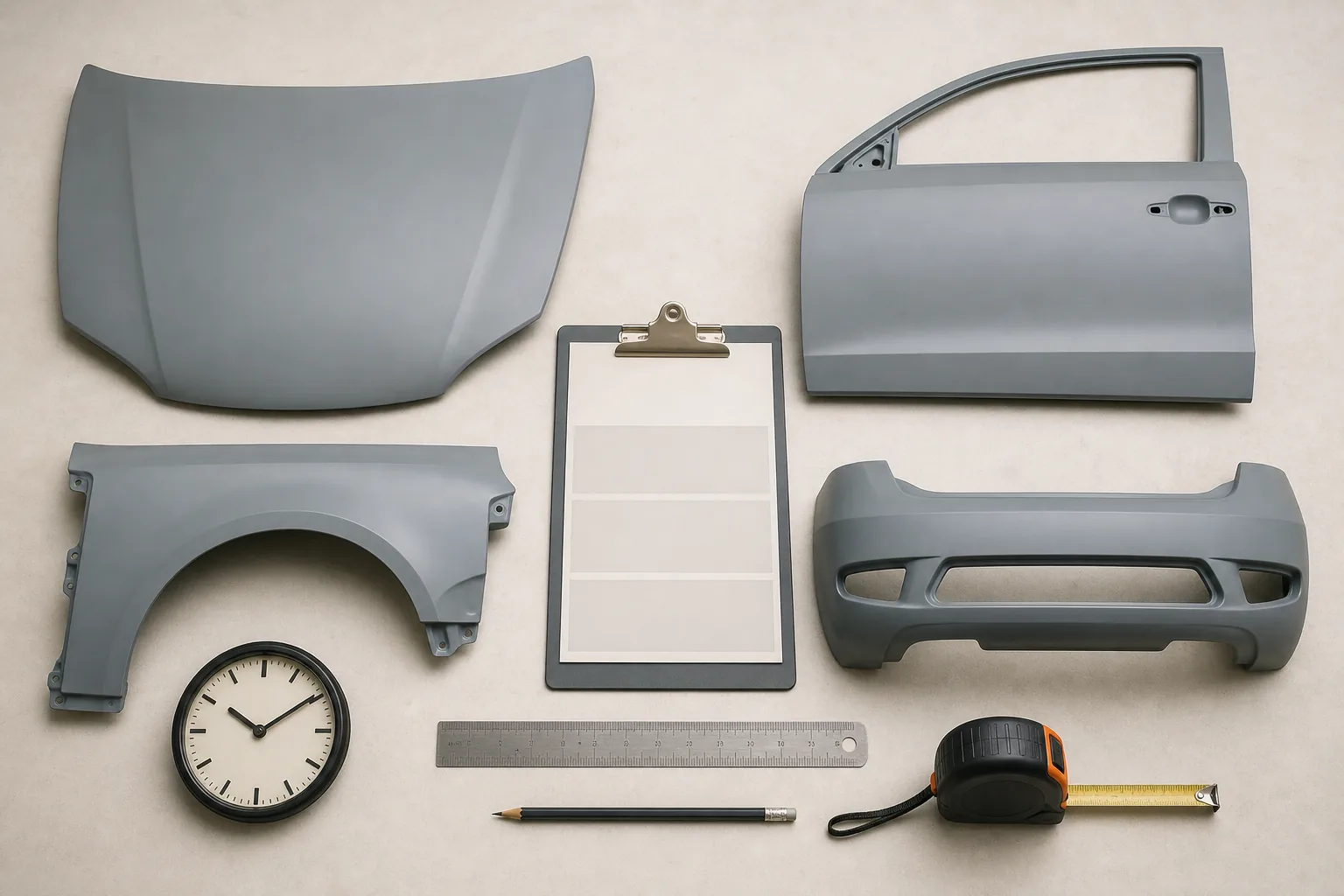
Add one row for a hood, bumper, door, fender, roof, quarter panel, deck lid, whole-vehicle group, or custom scope. Duplicate and reorder rows with explicit keyboard-operable buttons. One estimate can cover a single panel or a multi-panel planning job.
Every row accepts low, central, and high preparation hours, refinish hours, blend hours per adjacent panel, and materials. Job-wide inputs apply a labor rate, fixed fees, overhead, contingency, and optional tax. The result never creates a range by adding a hidden percentage.
Optional quote labels and totals are compared only on the current page. They are not included in shared links, saved by the site, or sent to measurement services.
Formula and variables
For each row and each scenario:
blend hours = adjacent-panel count × hours per adjacent panel
row hours = (prep + refinish + blend hours) × quantity
row labor = row hours × labor rate
row direct cost = row labor + materials per panel × quantity
For the complete job:
subtotal = all row direct costs + fixed fees
overhead = subtotal × overhead percentage
contingency = (subtotal + overhead) × contingency percentage
taxable amount = subtotal + overhead + contingency
total = taxable amount × (1 + optional tax percentage)
The result also divides the central total by total panel quantity. A per-area result appears only when every row has a valid area, avoiding a misleading partial denominator.
Worked example
Use example loads one hood, one adjacent panel, and three explicit scenarios. The central row uses 1.5 preparation hours, 3 refinish hours, 0.75 blend hour per adjacent panel, and $200 materials. The job uses $75 per hour, a $50 fixed fee, 10% overhead, 10% contingency, and zero tax.
Central labor is:
(1.5 + 3 + 1 × 0.75) × $75 = $393.75
Adding $200 materials and the $50 fee gives a $643.75 subtotal. Rounded overhead is $64.38. Contingency on $708.13 is $70.81, producing a $778.94 central demonstration total.
The separately entered low example produces $559.63, while the high example produces $1,028.50. These numbers demonstrate the cost layers. They are not market prices, labor standards, or quotes.
Assumptions and limitations
- Hours, labor rate, materials, fees, overhead, contingency, and tax are user-entered planning values.
- Panel names do not determine condition, scope, repair need, access, or operations.
- Blending is represented only by adjacent-panel count and explicit hours per adjacent panel.
- The model excludes diagnosis, hidden damage, structural repair, replacement parts, corrosion, calibration, disassembly details, supporting materials, facility requirements, and vehicle-specific procedures.
- Tax treatment and business cost bases vary; verify the sequence used by an actual quote.
- Low, central, and high scenarios should be explained by scope or uncertainty, not treated as probability bounds.
Use a qualified professional’s inspection and written estimate for a real vehicle. This calculator is budgeting information, not repair, chemical, preparation, mixing, spraying, pressure, ventilation, or safety instruction.
Frequently asked questions
Why enter three scenarios instead of a range percentage?
Separate values reveal what changes - hours, blend scope, or materials. A generic percentage would hide that explanation and imply false precision.
Are materials entered per job or per panel?
Each row’s materials are per panel and multiplied by its quantity. Fixed fees, rate, overhead, contingency, and tax are job-wide.
Why is per-area cost unavailable?
The denominator would be incomplete if any row lacked area. Enter a valid area for every row to show the central cost per square metre.
Can this estimate a whole-car paint job?
You can group repeated panels or create a whole-vehicle planning row, but you must supply the scope, hours, materials, and business assumptions. The calculator does not manufacture them from a vehicle class.
What happens to quote comparison values when I share?
Nothing. They stay on the current page and are not included in shared links, saved by the site, or sent to measurement services. A recipient sees only the calculator inputs included in the shared web address.
Last reviewed: by the Wrap & Paint Lab editorial team. Review the calculation methodology.